Beneficiary

Mark Hughes Foundation

Donate to Mark Hughes Foundation

97 Supporters

Raised

$6,747.03

Make a Difference


Sign up to Dry July 2026 and raise funds for Mark Hughes Foundation.

Spread The Word


Share this page to get friends to donate:

Leaderboards


Avatar Name Raised
1
$648
2
Jarome Foote
3rd Year
$578
3
Tess Marsden
3rd Year
$577
4
$465
5
$430
6
$424
7
$340
8
$338
9
Leanne Beutel
3rd Year
$206
10
Jack Welsh
3rd Year
$190
Avatar Name Raised
1
$1,080
2
$635
3
$142
4
$63
5
$63
$0
$0
$0

Fundraising For

Funds raised this Dry July will help fund brain cancer patient packs to provide information and care to Brain Cancer Patients across Australia

About Us

The Mark Hughes Foundation (MHF) is a leading brain cancer charity founded in Newcastle, NSW by Mark and Kirralee Hughes following Mark’s diagnosis with brain cancer in 2013. Driven by their personal experience, MHF was established with a clear mission — to fund vital research, raise awareness, and provide meaningful support to brain cancer patients and their families.
 
Every five hours, someone in Australia is diagnosed with brain cancer, and it remains the leading cause of cancer death in children. Brain cancer does not discriminate, and for many, it can be an incredibly isolating journey.
 
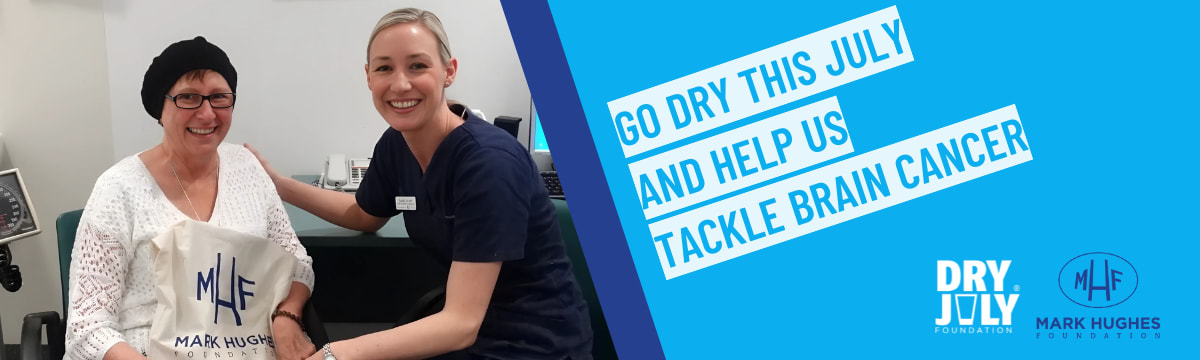
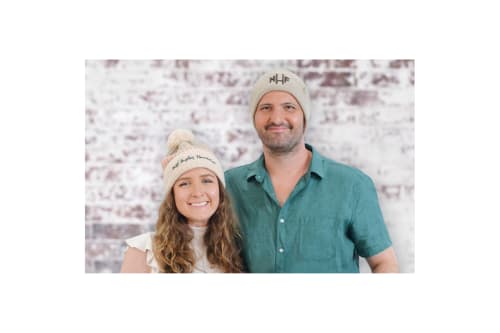
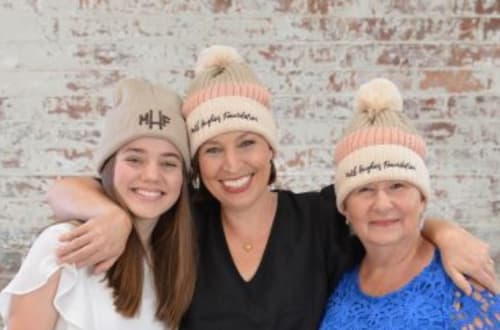
At MHF, we are committed to ensuring no one faces this diagnosis alone. To date, we have funded four dedicated Brain Cancer Care Coordinators, specialist nurses who walk alongside patients and their families from diagnosis through treatment and beyond, providing personalised care and support. In addition, every patient can access an MHF Patient Pack, which includes essential information, a survivorship diary, and our iconic MHF beanie — a powerful symbol of hope.
 
Support from initiatives like Dry July allows us to continue and expand this vital work. Since joining the program in 2022, MHF has delivered more than 3,000 patient packs to individuals and families across Australia. Funding from the 2026 Dry July campaign will enable us to grow this program further, ensuring every person diagnosed with brain cancer — no matter where they live — receives support, resources, and hope when they need it most.
 
No patient or family should have to face brain cancer alone.

Latest Updates


Lisa's Story

I have always been a supporter of MHF, buying beanies during the Beanie for Brain Cancer rugby league rounds, never imagining how personally meaningful this cause would become.

In November 2024, my younger sister Lesley received a diagnosis of Grade 4 Glioblastoma. Following her initial surgery, the prognosis was devastating—just 12 to 18 months to live. Our family’s world was instantly upended. At 53 and having just become a grandmother for the first time through her only daughter Carlie and her wife Lou, Lesley felt her life was finally whole with the arrival of little Tilly.

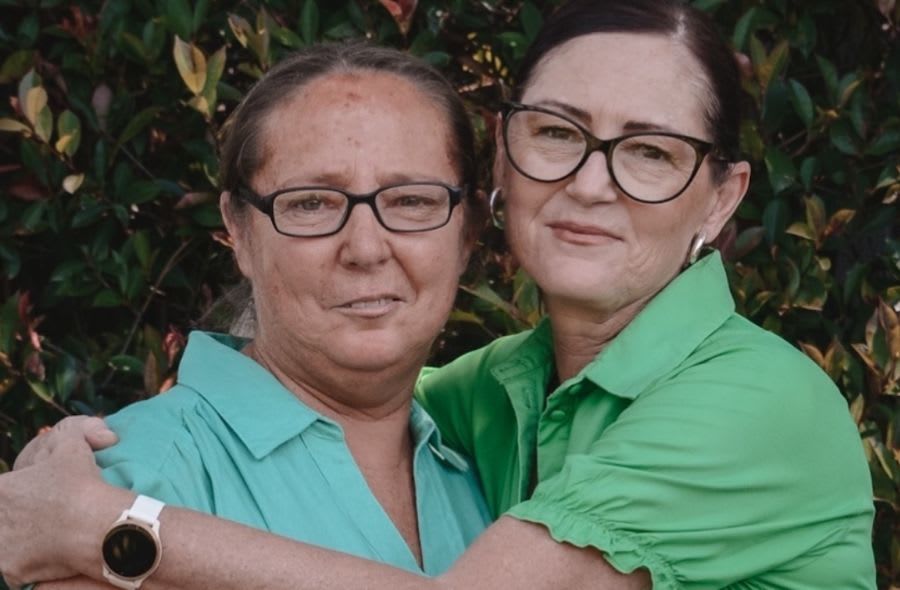
Lesley and I are two of five sisters, affectionately known as the “Ryan girls.” Together with our wonderful mum Denise, we made a pact to create as many cherished memories as possible. We’ve made the most of our time: climbing the Harbour Bridge with Lesley’s partner Nathan, enjoying family weekends away, enjoying sister trips with pampering, and even plotting tattoos—always seeking new adventures.

The outpouring of love and encouragement Lesley has received has been extraordinary—not just from family and friends, but strangers too.

The Mark Hughes Foundation was the first to extend support after her surgery, sending a care package that meant so much. Lesley has always been dedicated to the foundation, collecting every beanie since the campaign began, especially after previously losing a friend to the same terrible disease.

Lesley’s resilience and strength continually inspire us all. Supported by an excellent medical team and a loving network, she faces the daily challenges of this disease with courage.

We are determined to stand by her, and we will not give up this fight.

Simo's Story

Simon’s journey with brain cancer was devastatingly swift, yet his warmth, courage, and love for his family left a lasting impact that can’t be measured in words. Only a week after his diagnosis, Simon’s wife Heidi shared their story with the Mark Hughes Foundation, holding onto hope amidst the shock and grief. Just one week later, Simon was gone.

Simon was a beautiful 53-year-old (a young 53) who was always trying to be healthy and stay fit. He was a friend to all, and everyone always loved “Simo.” As a boy, he supported St George, but that changed once the Knights started in Newcastle. He always went to a few games each season with his mates, and this year we wanted to go as a family to support a family friend playing for the Knights, but Simo’s health was just not good.

You see, Simo had been struggling with Lyme Disease for the past three years and had been trying everything to get rid of it. It was getting worse, so we started to look into treatment over in Germany, but it is very expensive. Now we know those changes we started to see mid-year were probably the brain cancer.

Simo was a surfer; he loved the beach, and if he wasn’t in the water at least once a week it became evident that he needed his saltwater fix. His favourite breaks were Bar Reef and Nobby’s Reef. His favourite surfers were Mark Richards, Mark Occhilupo, Owen Wright, Jack Robinson, Mick Fanning, and Kelly Slater. We had been going to Rainbow Bay (near Snapper Rocks surf break) over the past four Easters. Simo was stoked to see Mick Fanning and Kelly Slater out in the surf and to meet Occy, who actually lives in the apartment building we stayed in. Occy was always up for a chat, and Simo was so excited that he got to introduce our son to one of the best surfers of all time.

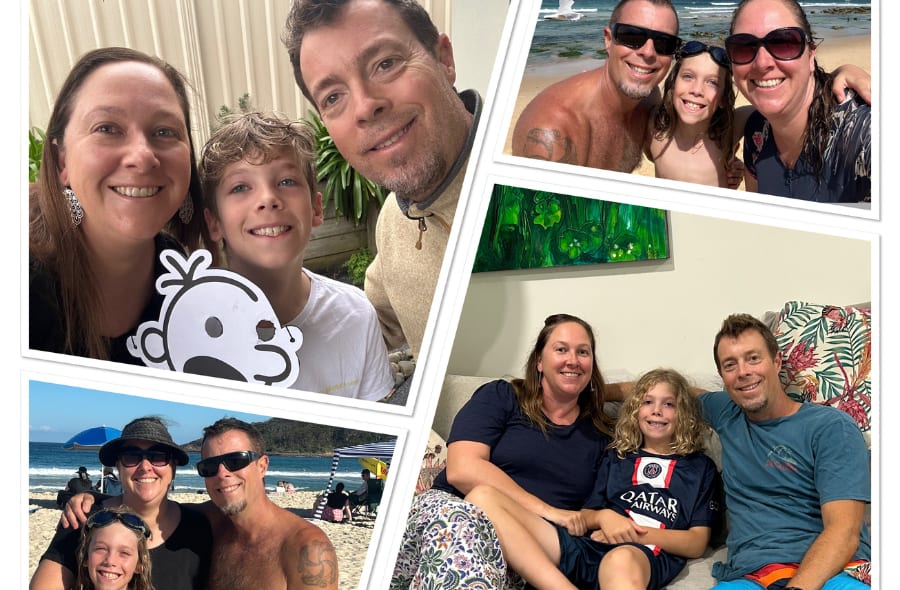
Simon was an amazing husband and father to our 10-year-old son, Newton. Newton adores his father, and Simon was born to be a dad. Simon was always outside playing soccer, on the trampoline, or in the spa playing with his little Newty Boy! The saddest part about all of this is that Newton’s world has been completely shattered and changed forever, and it breaks our hearts. We tried to protect Newton by keeping life as normal as possible. He knew Daddy was finding it difficult to find the right words to say (his tumour was in his front left lobe) and that doctors had done tests on his head to find the right medicine for him. We never thought he would be gone before he could even start radiation or chemotherapy.

Simo was always a loving and supportive partner and husband. We have been together 20 years and married for 12 years. In 2016, I decided to retrain and started a Masters of Education to become a Primary School Teacher. He was so supportive during this time when I was studying, especially as Newton was so young. In Term 2, 2019, I was doing my final practicum for my Masters and on 12th June (my mum’s birthday), our lives were derailed with the news that I had breast cancer — the nastiest and most aggressive type there is, Triple Negative Breast Cancer.

Just when life was meant to start to get easier, I had to have surgery, chemotherapy, and radiation. I tried to keep things as normal as possible and even worked while on chemo, much to my oncologist’s annoyance, as I needed to know that I could be a teacher prior to graduating that August. I then started casual teaching while I was doing radiation. I don’t know how I would have gotten through it without Simon.

I am now nearly five years post my treatments, and I will never forget when my surgeon said to me, "If you hadn’t found this early you would have been dead by 50." This still sits with me, especially now with Simo’s diagnosis — if I hadn’t caught it early, I hate to think what the outcome might have been for our son Newton.

Simon was a Geologist by trade and had worked in mines in NSW and WA. He worked for the NSW Department of Planning and Environment since 2005. He started in the Mine Subsidence Board, moved over to Minerals and Geological Survey, and later decided he wanted to get out of mining, so he moved to Fisheries and was working as a Senior Project Officer in Water Assessments.

He was still working the morning before we went to the GP on Tuesday 8th October and was reluctant to go as he had so much on at work, helping to cover while his manager was on leave. Who knew life could change so quickly after a 9:30 am GP appointment and then a 12:30 pm CT scan before being told that we needed to go to the John Hunter Hospital immediately?

The neurosurgeons thought it was a GBM, Grade 4 (a frozen section was taken on Friday 11th October during a biopsy). They said it was too risky to try to operate to resect some of the tumour as it might leave him with more deficits, like weakness in his right side or personality changes. We were holding onto the hope that radiation, chemo, and Avastin might start to reduce the tumour (5x4x3cm) and help Simon get back to how he was.

Once the pathology came back confirmed as a GBM Grade 4, we went to the medical and radiation oncologists and a treatment plan was in place. We were hopeful of getting Simon past Christmas this year, but the tumour was just too aggressive and took his life after just 20 days of fighting this beast.

Everything now feels very surreal, and we can’t process that Simon is gone. We couldn’t have navigated this journey without the wonderful MHF nurses, Elisha and Sandy — two amazing people who we will forever be so grateful for. We will continue to raise money and fight for a cure alongside the Mark Hughes Foundation, and we will not give up until a cure is found.

Liz's story

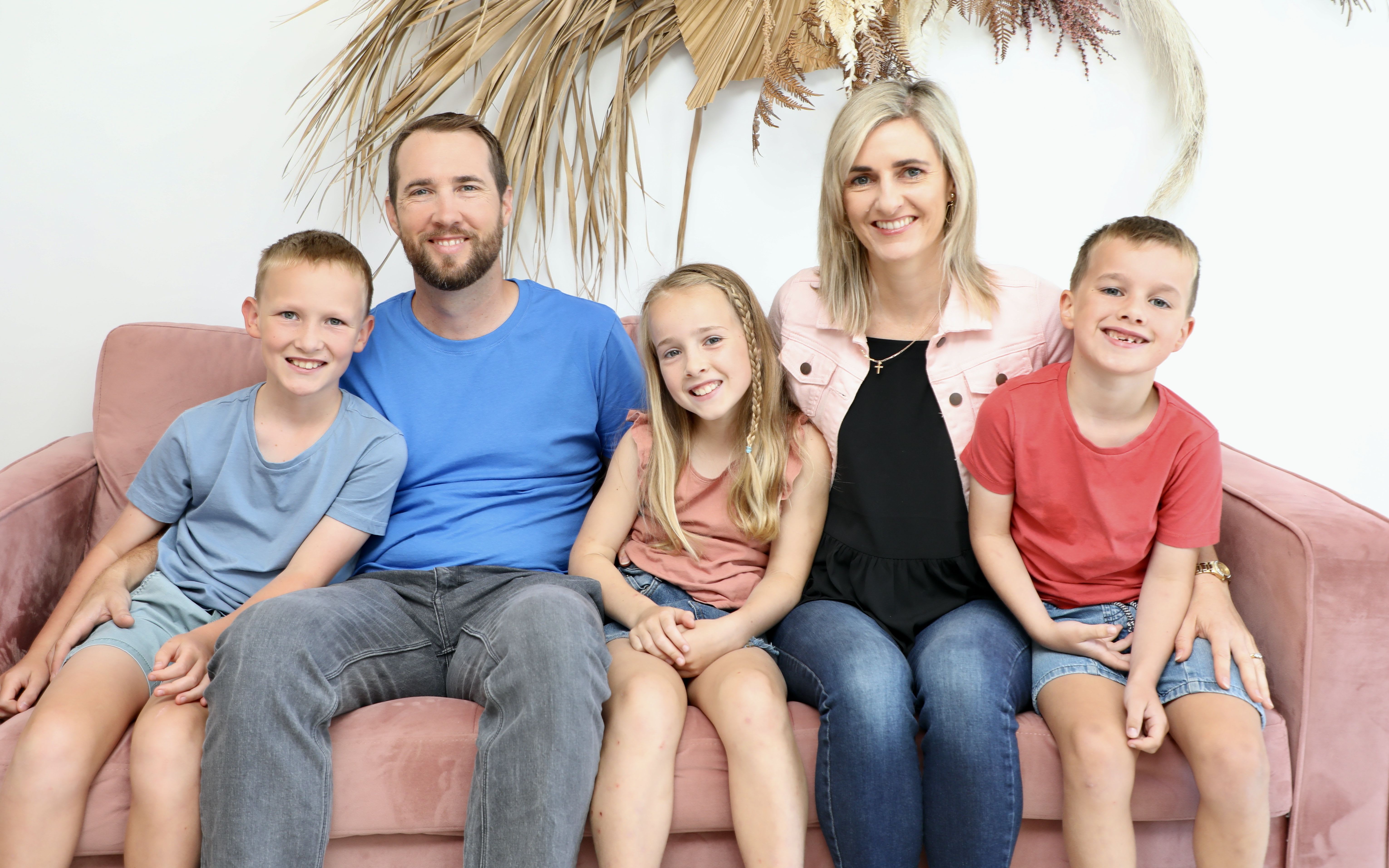
Hi, I’m Liz. I’m 37 years old, married to a spunky guy, mother to 3 beautiful children (6, 8, and 10) and I have brain cancer. And I can tell you, brain cancer sucks!

My extended family has had it tough with this disease. My cousin Luke passed away a number of years ago after living most of his life with a childhood form of the disease. Then his brother also had a brain tumour removed recently and my eldest sister Michelle was diagnosed with brain cancer almost 10 years ago too.

My journey with brain cancer started at home on the 10th June 2021. That’s the day I had my first seizure and my world changed forever.

In the lead up, I had been experiencing a large number of minor yet ever increasing symptoms like anxiety, tiredness, losing feeling in my leg, a twitching eye, and generally struggling with life. I’d been trying to get on top of things, but nothing was working. Sound familiar? It sounds just like every other busy mum with a young family, right? I mean, how was I or anybody else supposed to know I had brain cancer!

But then, one busy morning at home getting the kids ready for school, my lights went out. I don’t remember anything for a few days after that, but what I’ve been told is that I was having my first seizure of many. It was a full body, proper brain reset seizure, and I was having it in the hallway in front of my poor kids. And I was having it over, and over, and over again.

My kids went into emergency mode. God bless them, I have to laugh, they got out the medical kit, the Band-Aids, vomit bags, and bandages. All the medical type things that they’d seen us use before and that they thought might help. My kids were my first responders in a long line of people who would save my life that day. Eventually, my son Kayden (8 years) called Dad and told him “Something’s wrong with mum, she’s on the floor”, and Dad (my husband Scot) supposed that I had just passed out getting out of the shower, which I had been known to do. But once our friends and neighbours arrived on the scene to help and realised that something dreadful was happening, everything kicked into gear. Thank you to my kids, my husband, my family, my friends and neighbours, the ambo’s, the nurses, Drs, and all the other hospital staff who saved my life on that first day!

Six days later I had brain surgery to remove a chicken egg sized tumour from the front of my brain. The tumour was so big that it was squashing all the other bits of my brain and sort of putting them to sleep, like when you sit on your hand for too long or wake up at night and can’t feel your arm. All the early indications were that the tumour was benign, which was a relief. However, two days later my world was shattered when the proper biopsy results came back, and I was told that I had a high grade malignant brain cancer. Then a few weeks later I was shattered again when I was told what that really meant. “Glioblastoma Multiforme” … whatever that gobbledygook is. I couldn’t even pronounce it when I was told it. I already knew there was no cure, so I was absolutely petrified. Then they said, “Terminal illness, less than two years on average, but we’re hoping we can get you three”!

At this point, there really are no words to explain the crushing grief, tears, snot balls, and shaking from the inside out that I felt. I wouldn’t have a clue what the doctor said after that. It was like somehow the words the doctors were saying changed in the air between their mouths and my ears and I all I heard them saying was, “you won’t get to see your kids grow up”, “forget about going to their weddings”, “I bet they won’t even remember you”, “your husband will find someone else”. It was my world being taken away from me. Just like someone clicking their fingers. My world was there one second, and the next second it had been taken away.

But I’m a fighter! Four weeks after surgery I started a course of six weeks radiotherapy and chemotherapy. I did everything I could to keep well. I ate well to have the best nutrients in my body and exercised lots to help get the blood flowing into my brain to deliver more of the chemo to the cancer and kill it. The Drs describe the treatment as ‘tolerable’, but I can tell you it’s certainly no walk in the park. I almost made it to the end of treatment but had to stop the Chemo early because it had destroyed almost all my platelets so that I had a big risk of internal bleeding. I was very sick, but I was fighting. I didn’t realise how bad it was at the time, but later my Dr let slip just how concerned they were … something like a change of underwear being in order. I think I might have dodged another bullet there, and during COVID too!

Starting radiation during COVID was terrifying for me as I was all alone in the radiation room. I would lay on the machine with my head firmly fixed down under a plastic mask so that I couldn’t move. Not knowing what to expect, the radiation staff soon made me feel comfortable and Scot was beside me or as close as he could be, even if that meant being in the next room, or waiting in the car due to COVID restrictions. Thank you to my parents who came to our rescue as we still had the kids but now had to navigate daily radiotherapy while being very ill as well.

Since that time, I’ve been feeling much better, but life is so much different. I still have seizures and I still can’t drive at the moment (Grrrr) which means I can’t do basic mum things for my family (Double Grrrr). I take lots of regular medications, I see Drs all the time, have regular MRIs and I take Chemo every month to keep the cancer at bay. I’m up to 18months of Chemo which I’ll take until either my body won’t let me, or it stops working, or until they find a cure, or if I decide enough is enough. Praying hard for that cure!

However, the biggest change to my everyday life is that I can’t think the way I used to. Brain cancer impacts your ability to think because there is this cancer stuff inside your brain getting in the way and mucking everything up in ways that are different for everybody. For me, I struggle with higher level executive functioning like planning, administration and decision making (funnily enough … all the stuff I was really good at! Triple Grrrr). It sounds strange, but I can really struggle to make simple decisions. For example, if I try to plate-up for dinner, sometimes I just cannot work out what food goes on what plate. It is incredibly frustrating! Other things I can’t do anymore is write this story by myself, filter out background noise, prioritise lots of people talking all at once, and juggle different things competing for my attention. All this looks like seizures at family Christmas lunch, or at church, or while out to lunch with my friends.

As a result, my husband does a lot to help look after me and the kids, and I have a support worker come into my home a few days a week to help me do normal mum things.

To get past it all, I have to remember that I’m young, I’m fit, I’m otherwise healthy, I’m fighting, I’m doing well, Drs don’t know everything (Sorry Drs, you guys are great, but I know you would agree), my scans are good, I’m winning, I’m praying and seeking God, I have a great support network, and I have a great family who I love and adore and I WILL be there for them in the future!

A special thanks to the Mark Hughes Foundation (MHF) for giving me the opportunity to share my story and for all the work they are doing to find a cure.

Thanks to my MHF Brain Cancer Care nurses Alisha and Elise. You ladies are tops.

Thanks to my many Drs who give up so much of their lives to help people, like the extra time they spend at work away from their own families, so that I can get some more time with mine. I see your sacrifice.


Dry July 2023 funds are helping the Mark Hughes Foundation ensure no on goes through brain cancer alone

Dry July funds have enabled the Mark Hughes Foundation to continue supporting all patients and their families across Australia by providing all patients diagnosed with brain cancer a patient care pack, regardless of location.

Every patient can receive a patient pack, including information on the disease, a patient diary and our famous MHF beanie – which is a symbol of hope. No patient or family should have to go through a brain cancer diagnosis alone.

The funds also support the annual Hunter Brain Cancer Forum. The Forum is a day for patients, carers and their loved ones to hear specialists discuss a range of topics in relation to brain cancer. In addition to gaining further information and resources, the Forum helps patients build connections with other patients and carers going through the same journey. 


Michelle's Story

Michelle was enjoying life! A happy, healthy, busy life as a wife, mother of two, loving daughter, friend to many and a dedicated nurse.

She had a headache one morning before heading to a stressful day at the hospital during Covid in 2020. She thought little of it until the words on the patient's chart she was reading became completely unrecognisable. Michelle’s life was forever changed from that moment on.

2020 was a year like no other for me. This is the time when the whole world seemed to turn upside down and nothing would ever be the same again. This is where my story begins. July 2020. Also the year of the nurse.

There was nothing good for nurses in 2020 or for me personally. My name is Michelle, and up until this point in my life I was a busy working nurse, wife, mother to my 2 teenage children and friend to many. I had a very normal, full, happy and healthy life that was until I was diagnosed with brain cancer.

The Covid pandemic was upon us and life in the hospital was frantic, terrifying and uncertain. I was rostered on for a Saturday shift. I had a headache from the day before, but I had put this down to being stressed about Covid in the hospital and what I would be facing at work this day. It wasn’t unusual for me to start my day with a couple of Panadol tablets for a pounding headache, especially if there was any sign of stress.

By 11 am that day, I was reading patient notes, as is my usual routine, when I found I could not make any sense of the words I was reading. I turned the page but still the words were a jumble. I started to panic, wondering what was happening and turned my attention to the numbers printed on the patient bed- still I could not make sense of what I saw.

I rang home and spoke to my daughter- a wise 13 year old- she helped me calm down and confidently advised me to sit down while she her called her dad, Chris.

My husband wasted no time and was by my side before I knew it. Together we went to the ED of the hospital I worked in and explained my confusing episode. It felt strange to be in the hospital dressed in my nurse’s uniform sitting with patients, as I had become one. I had never needed the emergency department before. I waited to be reviewed. The doctor performed a range of tests and questioned me before informing me that I needed a CT scan. As I was feeling better by this stage and was able to make sense of words again, I felt this was unnecessary worry, and I should just go home.

I stayed for my CT scan, and was surprised with the worrying look on the faces of the staff when they asked me to come in and tell me the results of the scan. The doctors eyes welled with tears as she told me I had a lesion on my brain. I was going to need to stay in hospital and I was going to need surgery. I was told that my symptoms were the result of swelling on the brain and I had had a seizure. To say I was shocked was an understatement. I could not believe this was true and was happening to me.

Surgery was booked a few days later, and I had a craniotomy to resect the tumour and work out what type of tumour I was dealing with. The operation went as planned with no complications -except for Covid restrictions that meant my husband had to drop me at the front door of the hospital on the day of my surgery and my children couldn’t visit me while I was there. I couldn’t wait to get home to them. I just needed to see my neurosurgeon in 10 days for a review and the results of what they had removed. This was the real life changing event- when my surgeon informed me that the news was not good. I had a Grade 4 Glioblastoma. He told us I had a guarded prognosis and began to explain my treatment options. Chemotherapy, radiotherapy, sick and devastating- it was so overwhelming. My husband and I were in shock, my heart dropped to the floor and my sunshine dimmed. It was all a blur for me. We left his surgery and had no idea where to go and who to tell or what to do. We sat in our car just shocked at the news. I was wondering how I was going to tell me children who were waiting for me to call them. My mum was waiting too- it broke my heart to tell her- I know it broke hers too.

Half an hour after we left the surgery I got a call on my phone from one of the MHF Brain Cancer Coordinator nurses who spoke with us about what needed to come next. Who I would see, options I had, and how she would coordinate my treatment over the coming months. I felt real support and care. She gave me her number and told me to call with any questions or concerns I had.

Shortly after, I started radiotherapy and chemotherapy. The MHF nurse was there with me at every meeting and every step of the way as I navigated this strange new world of doctor’s appointments and oncology treatments. I had 6 weeks of daily radiotherapy and intense chemotherapy. Radiotherapy finished and chemotherapy continued for another 18 months after this.

All the while I received the best care. I received so much support and love and care, and found the MHF was there for me in my darkest time. I was helped to stay positive and became determined that life would get back to normal, albeit in a different kind of way. 8 months after my ordeal began I went back to work, this time as a nurse, not a patient.

Today I am pleased to say that I am well. I have a brain MRI every 2 months and I have been told there is no sign of the tumour. I am so thankful for this.

They say that every cloud has a silver lining. Today I have a new perspective. I am a better nurse – I have a new understanding of patients and the care I can give them. I understand how life can change in a moment as I have been there too. I recognise my blessings and am thankful for these. I am surrounded by love and friendship and blessed to have a beautiful family. I couldn’t ask for anything more.


Donate to Mark Hughes Foundation